Holisic Care
Mar 31, 2026
Why You Don’t Need a Crate for Separation Anxiety Training (And What to Use Instead)
Separation anxiety doesn’t have to catch you off guard. Learn how to practice departures without leaving using the ‘What If’ Game, so your dog knows what to expect and stays calm.

Emma Suarez Berumen
Founder of Snout
Follow Snout
Why Crates Can Do More Harm Than Good (And What the Science Says)
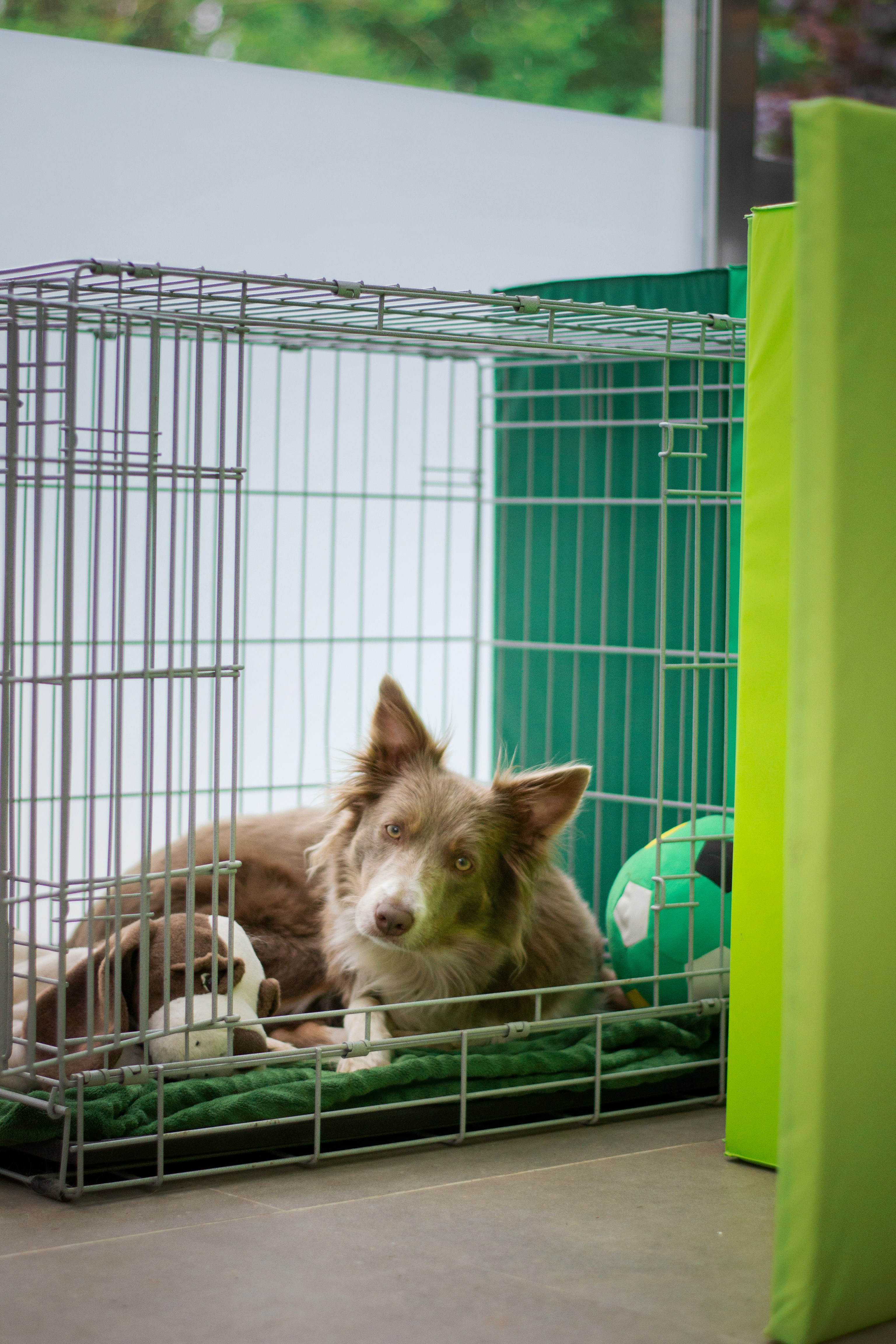
Crates are often recommended as a "safe space" for dogs with separation anxiety—but if you are training using a desensitization protocol, you won't need a crate. In some cases, crates can even do more harm than good. Here’s why:
1. Crates Can Increase Anxiety (Confinement Anxiety)
Dogs with separation anxiety often associate crates with being trapped, which can trigger or worsen confinement anxiety.
Example: A dog who is panting, whining, or scratching at the crate door is showing clear signs of distress—not safety.
A 2021 study in Applied Animal Behaviour Science found that dogs with separation anxiety showed higher cortisol levels when confined to crates vs. open spaces.
Confinement anxiety is a real condition where dogs panic when restricted, even if their owner is home.
2. You Can’t Read Body Language in a Crate
Crates obscure critical stress signals (e.g., pacing, tense body, lip licking).
During training, your will need to accurately identify stress signals which much easier when the dog has space to move around.
Example: A dog might freeze in a crate, making it look like they’re "calm"—when they’re actually shutting down from stress.
3. Crates Don’t Teach Independence
The goal of separation anxiety training is to teach your dog to be relaxed while home alone.
Desensitization protocols help eliminate stress related behaviors like destroying things, urinating, and escape attempts.
Once your dog learns to relax on their own, there is no longer a need for confinement.
Snout Insight:
"A crate isn’t a solution, it’s a band-aid that can mask the real problem. True progress happens when your dog learns to be calm and confident in any space."
Ready to ditch the crate and teach your dog true independence? Join Snout’s newsletter for weekly crate-free training tips, puppy-proofing guides and more.
Newsletter
The Crate-Free Approach, How to Train Without Confinement
Depending on your home's layout and your dog's specific behaviors, you may still need a safe way to confine your dog while implementing a training protocol.
Here are 3 crate alternatives that reduce stress and allow for better observation:
1. Exercise Pen
This is a foldable metal fence that can be used to create a play-pen (great for puppies!) or block off or divide spaces.
Why It Works:
Provides more space than a crate but still contains your dog safely.
Can be configured a variety of way to fit any space.
More than one pen can be used to create a larger space, while still keeping your dog contained.
2. Baby Gate
This is a gate used to block doorways- usually mounted to the door frame and has a gate that opens and closes.
Why It Works:
Blocks off a room (e.g., kitchen, bedroom) while allowing your dog access to approved areas.
Example: Use a baby gate to block the hallway and kitchen, while allowing them access to the living room.
3. Free-Roaming
This means your dog has access to an entire space- usually the main living area of the home. Typically, dogs with confinement anxiety will still panic if closed into a smaller room like a bathroom or laundry room, so the more freedom you can offer your dog, the better.
Why It Works:
No confinement = no confinement anxiety.
Gives your dog more agency and the ability to choose where they are most comfortable. This helps build confidence and reduce stress.
Example: A puppy-proofed living room with chew toys, a water bowl, and a designated "safe spot" (e.g., a dog bed with familiar blankets).
Snout Insight:
"When choosing a space for your dog to free-roam, consider where you spend the most time with your dog while your home. This is typically where the dog feels most comfortable and the best choice for a puppy-proofed training zone."
The Ultimate Puppy-Proofing Checklist (So You Can Ditch the Crate Safely)
How to Puppy-Proof Your Home for Crate-Free Training
Puppy-proofing is essential for crate-free training. Here’s how to remove hazards and create a safe space in every room, The Puppy-Proofing Checklist.
Room | Hazards to Remove | Safe Alternatives |
|---|---|---|
Living Room | Electrical cords, small objects | Cord covers, toy baskets |
Kitchen | Trash cans, toxic foods (chocolate, grapes) | Childproof locks, secured trash |
Bedroom | Shoes, clothing, small decor | Closed closets, elevated storage |
Bathroom | Toilet lids, cleaning supplies | Closed doors, high shelves |
Entryway | Shoes, coats, bags | Hooks, closed closets |
Putting It All Together
Combine all 3 crate alternatives for a safe and thoroughly puppy-proofed home.
For Example: Your dog feels most comfortable relaxing on the couch in the living room, but might get into trouble in the kitchen or bathroom. Puppy proof the living room by removing potentially dangerous items, or items that your dog might destroy, like shoes and pillows. Use a exercise pen or baby gate to block access to the kitchen, and close the bathroom door.
Example:
Snout Insight:
"Puppy-proofing isn’t about restricting your dog—it’s about freeing them to learn independence safely."
Free-Roam Test: Determining If Your Dog Has Confinement Anxiety or Separation Anxiety
Now that you know the crate can be a source of anxiety and some alternatives, you can test whether your dog is also experiencing separation anxiety.
Step 1: Set up your space
What to Do:
Choose an area of the home where your dog can free roam (either the whole home or just part of it).
Puppy proof the area using tips from section 3.
Step 2: Set up your camera
What to Do:
Set up a dog camera or even a phone or other device that can record.
Try to capture the area your dog normally hangs out when you are home (their dog bed, the couch, etc)
Make sure you can also see the front door, since dogs with separation anxiety will typically spend tie near the exits.
Step 3: Leave
What to Do:
Follow your normal departure routine, and leave!
Stay close by (drive around the corner and park for example) so that you can come back quickly if your dog panics.
Step 4: Wait & Observe
What to Do:
If you can watch your dog camera in real time, observe your dog's behavior for 15-30 minutes
If you can't see a live feed, return after 15 minutes and watch the recorded footage.
Take note of your dog's body language and behavior: do they lay down and close their eyes, pace and whine, scratch at the door? Does their behavior escalate the longer you're gone, or do they calm down?
If your dog was able to relax or settle down during your test exit, they most likely do not have separation anxiety! The panic you were seeing inside the crate was just confinement anxiety.
If you see the same panic during the free-roam test, then your dog is likely experiencing separation anxiety and it's time to seek professional help.
Snout Insight:
"Diagnosing the source of your dog's stress is the first step in helping them recover."
Why Your Crate-Free Training Isn’t Working (Common Mistakes and How to Fix Them)
Even with the best plan, setbacks happen. Here’s how to fix the most common issues:
1. "My Dog Panics When I Leave."
Why It Happens:
Your dog is likely experiencing separation anxiety
Unfortunately for some dogs, allowing free-roaming is not enough to resolve their stress.
How to Fix It:
Treating separation anxiety involves a structured desensitization protocol to help your dog feel safe when home alone.
2. "My Dog Is Destructive When Free-Roaming."
Why It Happens:
Puppy-proofing missed hazards (e.g., a shoe left out, an unsecured trash can).
Your dog isn’t ready for full free-roam.
How to Fix It:
Revisit puppy-proofing (get on your hands and knees—what’s tempting?).
Use a baby gate or exercise pen as a middle step before full free-roam.
Example:
"My dog chewed the couch when left alone. We blocked off the couch with an exercise pen and gradually expanded her space."
4. "My Dog Follows Me Everywhere—Even in a Safe Space."
Why It Happens:
Your dog hasn’t learned independence yet.
They associate your presence with safety.
How to Fix It:
Practice "alone time" while you’re home (e.g., close the bathroom door for 30 seconds).
Reward calmness when your dog chooses to stay in their safe space.
Example:
"My dog followed me to the bathroom. I started closing the door for 10 seconds, rewarding her for staying. Now she naps in her bed while I shower!"
Snout Insight:
"Setbacks aren’t failures, they’re data. Adjust one thing at a time, and you’ll find the right rhythm for your dog."


Follow Along
Enjoyed the Read?
Share it and follow Snout across our social channels for more such relatable insights
Recomendation
Explore Related Topics
Read more related topics on
Holisic Care